
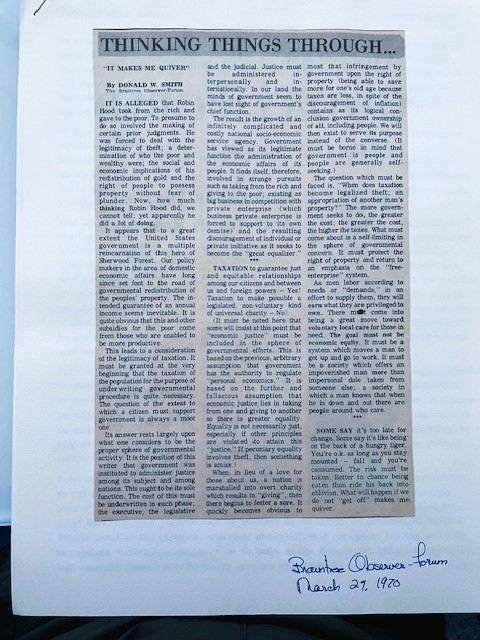
Published in the Braintree Observer Forum on March 29, 1970
Written by Donald W. Smith.
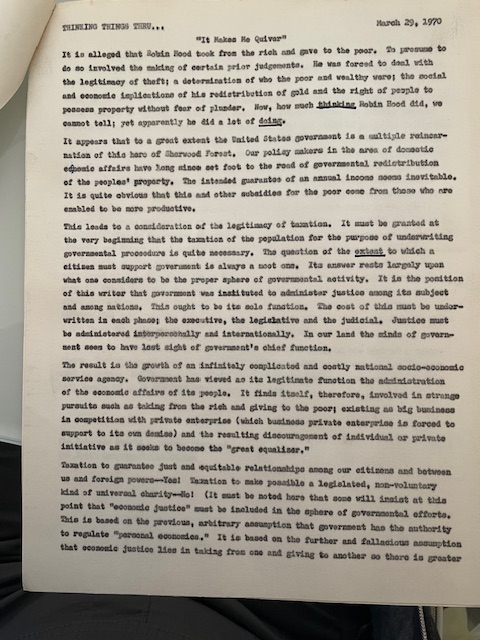
It is alleged that Robin Hood took from the rich and gave To the poor. To presume to do so involved making judgments. he was forced to deal with the legitimacy of theft; a determination of who the poor and wealthy were the social and economic implications of his redistribution of gold, and the right of people to possess property without fear of plunder. Now, how much thinking Robin Hood did, we cannot tell; yet apparently he did a lot of doing.
It appears that to a great extent the United States government is a multiple reincarnation of this hero of Sherwood Forest. Our policy makers in the area of domestic economic affairs have long since sent foot to the road of governmental redistribution of peoples property. The intended guarantee of an annual income seems inevitable. It is quite obvious that this and other subsidies for the poor come from those who are unable to be more productive.
This leads to a consideration of the legitimacy of taxation. It must be granted at the very beginning that the taxation of the population for the purpose of underwriting governmental procedure is quite necessary. The question of the extent to which a citizen must support government is always a moot one.
It answer rests largely upon what one considers to be the proper sphere of governmental activity. It is the position of this writer that government was instituted to administer justice among its subjects, and among nations. This ought to be its sole function. The cost of this must be underwritten in each phase; the executive, the legislative, and the judicial. Justice must be administered interpersonally and internationally. In our land, the mind of government seem to have lost sight of government chief function.
The result is the growth of an infinitely complicated and costly national socioeconomic service agency government has viewed as its legitimate function, the administration of the economic affairs of its people it finds itself, therefore, involved in strange pursuits, such as taking from the rich and giving to the poor; existing as big business in competition with private enterprise (which business private enterprise is forced to support to its own demise) and the resulting discouragement of individual or private initiative, as it seeks to become the “great equalizer”.
Taxation to guarantee just an equitable relationships among our citizens and between us foreign powers-yes! Taxation to make possible legislated, nonvoluntary, kind of universal charity – No!
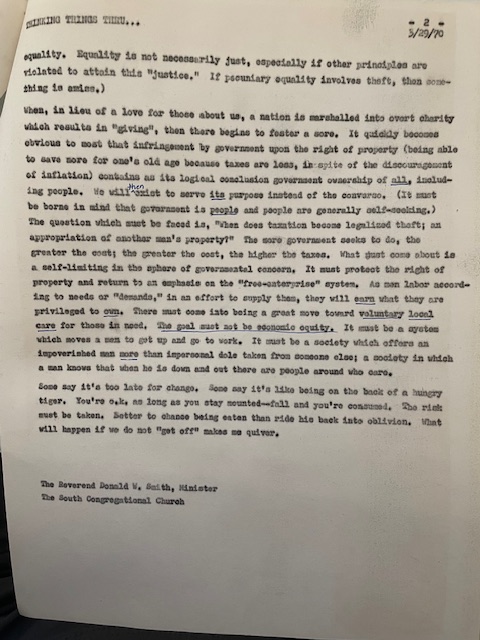
(It must be noted here that some will insist at this point that “economic justice“ must be included in the sphere of the governmental efforts. This is based on the previous, arbitrary assumption that the government has the authority to regulate “personal economics“. It is based on the further and fallacious assumption that the economic justice lies in taking from one and giving to another so there’s greater quality. Equality is not necessarily just, especially if the other principles are violated to attain this “justice“. If pecuniary equality involves theft, then something is amiss.)
When, in lieu of a love for those among us, a nation is marshalled into overt charity, which results” giving” then there begins to fester a sore. It quickly becomes obvious to most that the infringement by government upon the right of property (being able to save more for ones old age, because taxes are less in spite of the discouragement of inflation) contains as its logical conclusion, government ownership of all, including people. We will then exist to serve its purpose instead of the converse. It must be born in mind that government is people and people are generally self-seeking.
The question is, “when does taxation become legalized theft; and appropriation of another man’s property?” The more government seeks to do, the greater the cost; the greater the cost, the higher the taxes. What must come about is a self-limiting in the sphere of governmental concern. It must protect the right of property and return to an emphasis on the “free enterprise” system.
As men labor, according to needs or “demands”, in an effort to supply them, they will earn what they are privileged to own. There must come into being a great move toward voluntary local care for those in need. The goal must not be economic equality. It must be a system which moves a man to get up and go to work. It must be a society which offers an impoverished man more than impersonal dole taken from someone else; a society in which a man knows that when he is down and out there are people who care.
Some say it’s too late for change. Some say it’s like being on the back of a hungry tiger. You’re o.k. as long as you stay mounted – fall and your consumed. The risk must be taken. Better to chance being eaten then ride his back into oblivion. What will happen if we do not “get off “makes me quiver.
 Reverend Donald W. Smith Ministry Foundation Inc. :Devotions, Wisdom, Sermons, Mental Wellness, Insights, Theology & Hope