
Published in the Braintree Observer Forum on April 12, 1970
Written by Donald W. Smith
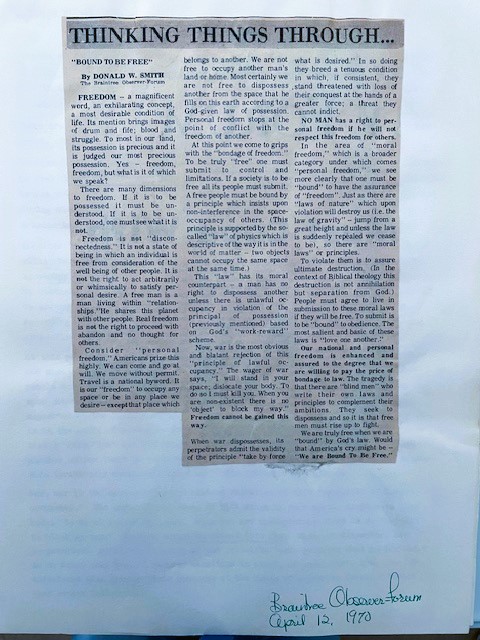
Freedom a magnificent word, an exhilarating concept, a most desirable condition of life. It’s mentioned brings images of drum and fife; blood and struggle. To most in our land, it’s possession is precious, and it is judged our most precious possession. Yes, freedom but what is it of what we speak?
There are many dimensions to freedom. If It is to be possessed, it must be understood. If it is to be understood. One must see what it is not.
Freedom is not “disconnectedness“. It is not a state of being in which an individual is free from consideration of the well-being of other people. It is not the right to act arbitrarily or whimsically to satisfy personal desire. A free man is a man living within “relationships”. He shares this with other people. Freedom is not the right to proceed with abandon and no thought for others.
Consider “personal freedom”. Americans prize this highly. We can come and go it well. We move without permit. Travel is a national byword. It is our freedom to occupy any space or be any place we desire – except that place which belongs to another. We are not free to occupy another man’s land or home. Most certainly we are not free to possess another from the space that he feels on this earth according to a God-given law of possession. Personal freedom stops at the point of conflict with the freedom of another.
At this point we come to grips with “bondage of freedom.” To be truly free one must submit to control and limitations. If a society is to be free at all, its people must submit. A free people must be bound by a principal which insist upon non-interference in the space occupied of others. (This principle is supported by the so-called “law” of physics, which is descriptive of the way it is in the world of matter—2 objects cannot occupy the same space at the same time).
This “law” has its moral counterpart – a man has no right to dispossess another unless there is unlawful occupancy in violation of the principal of possession (previously mentioned) based on God‘s “work – reward” scheme.
Now, war is the most obvious and blatant rejection of this principle of lawful occupancy. The wager of war says I will stand in your space; dislocate your body. To do so I must kill you. When you are nonexistent, there is no “object to block my way”. Freedom cannot be gained this way.
Where war dispossesses, it’s perpetrators, admit the validity of the principal “take by force what is desired“. In so do they breed a tenuous condition in which, if consistent, they stand threatened with loss of their conquest at the hands of greater force; a threat they cannot indict.
No man has a right to personal freedom if he will not respect the freedom of others.
In the area of moral freedom which is a broader category under which which comes “personal freedom”, we see more clearly that one must be “bound “to have the assurance of “freedom”. Just as there are “laws of nature”, which upon violation will destroy us (i.e. the “law of gravity” -jump from a great height, and unless the law suddenly repealed we cease to be), so there are “moral laws” or principles.
To violate them is to assure the ultimate destruction. (In the context of biblical theology this destruction is not annihilation, but separation from God). People must agree to live in submission to these more laws if they will be free. To submit is to be “bound” to obedience. The most basic of these laws is “love one another”.
Our national and personal freedom is enhanced and assured to the degree that we are willing to pay the price of bondage to law. The tragedy is that there are “blind men” who write their own laws and principles to complement their ambitions. They seek to dispossess and so it is that free men must rise up to fight.
We are truly free when we are “bound” by God’s law. Would that America’s cry might be “We are Bound to Be Free.”
 Reverend Donald W. Smith Ministry Foundation Inc. :Devotions, Wisdom, Sermons, Mental Wellness, Insights, Theology & Hope